Janine Allen - Professional Dog Trainer
  • Home
  • FAQs and TIPS
  • Blog
  • Forms
  • My Credentials
  • Contact
  • Board and Train
  • Service Dog Training

Hierarchy of Behavior Change

7/9/2017

1 Comment

 
​
I love when I board and train dogs because I get to have far more control of the dog's learning environment than when I am training a dog in its own home or teaching a group class. For the most part, this means I can reach my training goals more quickly. But, no matter what amount of training the dog gets, an owner still needs to understand the concepts since "trained" is never a static word in the world of dog behavior. Even the best service dogs and police dogs need continual schooling and refresher sessions in all the wonderful things they do.
​

Several people have sent me this article. It is fabulous, with a very modern approach to training (I am so glad that we keep improving). Perhaps it is too trainer-y for most, but take a look. Under the first listing, "Commits to using the most positive, least intrusive training methods," is the hierarchy of behavior change. This is a guideline to the general steps in creating a successful outcome with the least amount of emotional stress on the dog. The Certification Council for Professional Dog Trainers also has a position statement on the application of the Humane Hierarchy, a similar series of steps that keep training more positive and less intrusive. 

I have expounded on these below for ease of understanding:

1. "Medical, nutritional, physical"
A dog that is in physical pain, cranky from a metabolic or hormonal disorder, is too hot, too cold or overly hungry is going to have a difficult time learning or may be displaying behavior that cannot be changed by any of the steps below. When in doubt, vet it out.

2. "Antecedent arrangement"
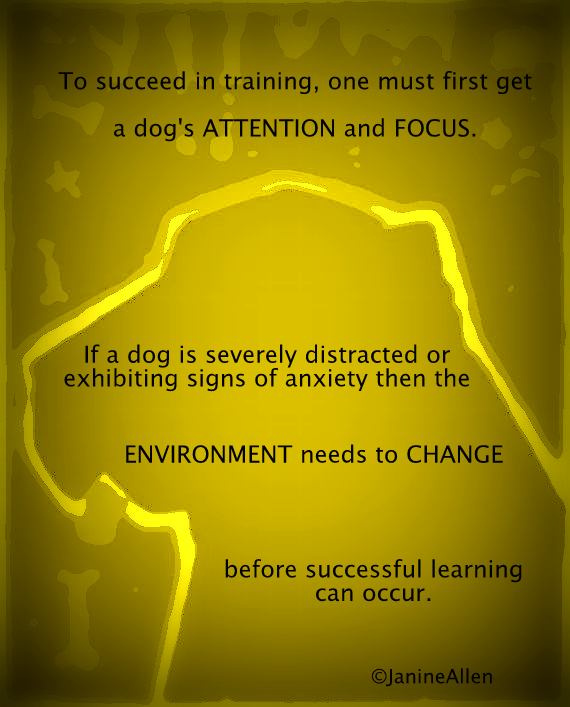
An antecedent is a thing or event that existed before the behavior occurred. This would be referring to the environment in which the dog is acting or reacting. Learning is difficult with lots of distractions so you would want to set up your dog's learning environment accordingly. In some aspects of dog training we use the word "trigger." Like during a thunderstorm the antecedent triggers a dog to hide under the bed. When a squirrel runs across the property it triggers a dog to get excited. Professional trainers are very attuned to the all the things in the environment that are possible causes for a dog's behavior. They will ask you many questions about this if dealing with behavioral challenges.

3. "Positive reinforcement"
Well, of course, you say! It's the current buzz word of the dog training community! But positive reinforcement is only positive if the dog perceives it as being reinforcing. Each dog has its own value system for reinforcement and that needs to be assessed (and possibly manipulated) before training begins. Most humans expect dogs to want to work for affection but, sadly, this works for a low percentage of dogs. In competition and working dogs, where we need precise and reliable behavior, we use food, toys, and play as rewards. But, if we are giving this stuff away free, all day long to our dogs, it probably won't be something they want to work for.

4. "Differential reinforcement of alternative behavior"
This basically means that you will ignore unwanted behavior (barking, jumping, pawing, lunging) while rewarding something else. It is frequently termed "give the dog something TO DO instead of telling it what NOT to do." If you want the dog to do a specific behavior like sit or lie down, you will need to teach it to do this reliably in a quiet learning atmosphere before using it as an alternative behavior.

5. "Extinction, negative reinforcement, negative punishment"
Extinction is making sure the dog receives no rewards for undesirable behavior. A dog who jumps on you may find the act of jumping and touching your body very rewarding. That same dog may interpret you pushing him down or yelling at him as rewarding because he is at least getting your attention. Identifying what is rewarding and not rewarding is an important skill for professional dog trainers.

Negative reinforcement is when you remove something to reinforce behavior. This could simply be an act of holding onto a dog's collar until he settles down before releasing him to   greet a person or dog. Another example of this would be putting slight tension on your dog's collar when you want to change directions during a walk. When he yields to the pressure you release the tension.

Negative punishment is when you take something away to stop behavior. When a puppy jumps against his exercise pen or baby gate as you approach him, you can immediately turn around and walk the other way. Keep repeating and the pup soon learns that jumping on the pen causes you - the thing he really wants - to go away. 

6. "Positive punishment"
Notice how this is in its own level - the last one - within the hierarchy? That is because positive punishment has a higher chance of fallout or side effects. It can create distrust in your dog. It can be more damaging if incorrectly used than any of the other types of reinforcement or punishment listed above. Positive p
unishment is when you add something to the environment to stop future occurrences of that behavior. It could be something uncomfortable or painful to the dog, or a sound that startles the dog into stopping what he is doing. It does not always invoke fear or stress; it could be simply stepping in front of the door each time it is opened to stop the dog from attempting to dart out. When the dog starts anticipating that you will step in front of the door, and no longer gets out of his bed when you open the door, positive punishment has occurred.
1 Comment

Paying it forward - free email support

6/24/2017

0 Comments

 
So many people have been kind and generous to me in my times of need. I would like to pay it forward to those who are, for whatever reason, unable to hire a trainer at this time. During the month of July I am offering a free email assessment and support to those who need help. Please fill out this Behavior Questionnaire and type "Pay it forward" in the promotion code box on the last page. I will email you back a confirmation that I have read your questionnaire and we will start working on a training program.

While it is best to work with you and your dog in person, much can be accomplished through email. 
Picture
0 Comments

Will you label it or fix it?

6/15/2017

0 Comments

 
One of my biggest time-consumers in the dog training world is helping owners understand their dogs' behaviors and emotions. The other day, at a dog social hour, the owner kept telling the crowd that her dog was a prima donna because the pup wouldn't leave its thrown on the golf cart to visit the other dogs. Everyone joined in on commenting on "the princess." Nothing was done to find a way to motivate the dog to get off the golf cart. When the crowd was distracted, I pulled the treats out and got a majority of the dogs to run around with me, including the housemate of the dog sitting on the cart. Very soon after that, the mocked pup hopped off her perch and joyfully ran over to me.

Eventually the owner asked why her dog had such an attitude and why she always barked at dogs she had never met before. She was quick to blame its upbringing in the show dog world.  Believe me, it would be a rare breeder or show handler who would tolerate a dog who barks at every new dog it meets. I explained to the owner that a dog who lacks confidence in greeting other dogs will do every type of body language to defend itself: growling, lifting lips to show teeth, snapping, tucking tail, running away, and yes, even barking. This type of behavior can be greatly minimized if an owner will spend time doing the proper rehabilitation to build a dog's confidence. I also explained that letting the dog continue to do this will cement the behavior in the dog's neuropathways (practice makes perfect!) and could possibly get worse.

Odd, unwanted, ugly, dumb, fearful, aloof, aggressive, stupid, weird, behavior. Will you label it or will you fix it?
0 Comments

Anticipation - when it works, when it doesn't

2/7/2017

2 Comments

 
 Anticipation - when it works, when it doesn’t

We have all seen it in our dogs. The dog who bounces about when a visitor comes, barks when headed to the dog park, or whines when he sees a tennis ball. The dog who acts worried when he anticipates a bath, drags his feet to the vet, or gets stiff when he sees another dog. Your proper reaction to that anticipation will help reduce anxiety for both you and your dog while affirming your leadership role. More importantly, your response to your dog’s anticipation, before he follows through with action, will create less work for you and will receive more understanding from your dog.

First, you will have to decide if the anticipation is working for or against you. Anticipation of a treat, toy, ball is great when you are using those for rewards. We love this when training the dog to do most things. Dog predicts he will get a treat so, boom, he quickly sits down for his reward. Dog expects the ball to be launched and, bam, immediately retrieves when the ball is thrown. On the other hand, a dog that anticipates a visitor’s attention may lead to jumping on the visitor. A dog that anticipates a neighborhood jaunt will zoom out the front door as soon as it is opened.


Then, you will need to decide how to respond to the anticipation. A dog who anticipates some sort of procedure at the vet clinic needs some rehab exercises so he can see things more positively. Drive dog to clinic, get out of car, play tug, eat food, go for a walk, go home. Repeat, repeat, repeat. Progress to walking inside, hand feeding bit-by-bit (whole meals if necessary), going back outside for a walk then going home. Vet staff are always willing to help dogs overcome anxiety so have them hand a bit of food to your dog.

​*Note: the vet clinic is NOT the place to obedience train an anxious dog. Nor is it a place to force your anxious dog to behave around other dogs. This will only add to anticipation and anxiety.


When a dog anticipates a walk, the likelihood of him remaining calm while you put the leash on is low and the chances of him pulling are high. You would not want to encourage anticipation by asking him if he wants to go for a walk or by moving about quickly and joining in the excitement. You can reduce this type of anticipation by frequently, throughout the day, bringing out the leash putting it on the dog, then removing it and going about your business. If the dog delays his anticipation until you are outside the door, you can bring him back inside for a few minutes and remove the leash then put it on before going out again. Repeat as necessary until he is calm before proceeding with the walk.

Using valuable rewards can deflect a dog from anticipating a future event. When your dog anticipates a visitor’s arrival, step on his leash and generously toss bits of food on the floor, away from the visitor, before he jumps on your guest. Do this consistently with each and every guest. When your dog anticipates running out an open door, tether him so that he can move freely outside and inside the door. Open door and throw several pieces of food behind him so his new anticipation will be running back inside instead of outside. If a dog has practiced many months or many years of anticipation it will take many repetitions to change this behavior. Be consistent and be patient.
​

When you have found something that your dog really likes to do, and anticipates that action, you can use it as a reward for a training exercise. Instead of going outside and throwing the ball over and over again, have your dog sit or lie down before each toss. Better yet, use the ball toss as a reward for things your dog may be hesitant to do like getting in the car or having his feet handled. Anticipation can really help train a fast, reliable recall. Have someone hold your dog back at the other side of the yard while you bounce the ball and, when he is just about screaming to get to you, call his name and give him the ball. Lock up some tasty food in a crate and let your dog spend several minutes on the outside anticipating eating the food. When you open the door he will zoom right in.


I hope this article has caused you to anticipate a better future with your dog. 
2 Comments

Happy Holidays

12/23/2016

1 Comment

 
May you and your dogs have a wonderful Christmas, Chanuka, Kwanzaa, New Year and whatever else you are celebrating during these winter months. I like to celebrate the longer days since I get more outside time with the dogs.

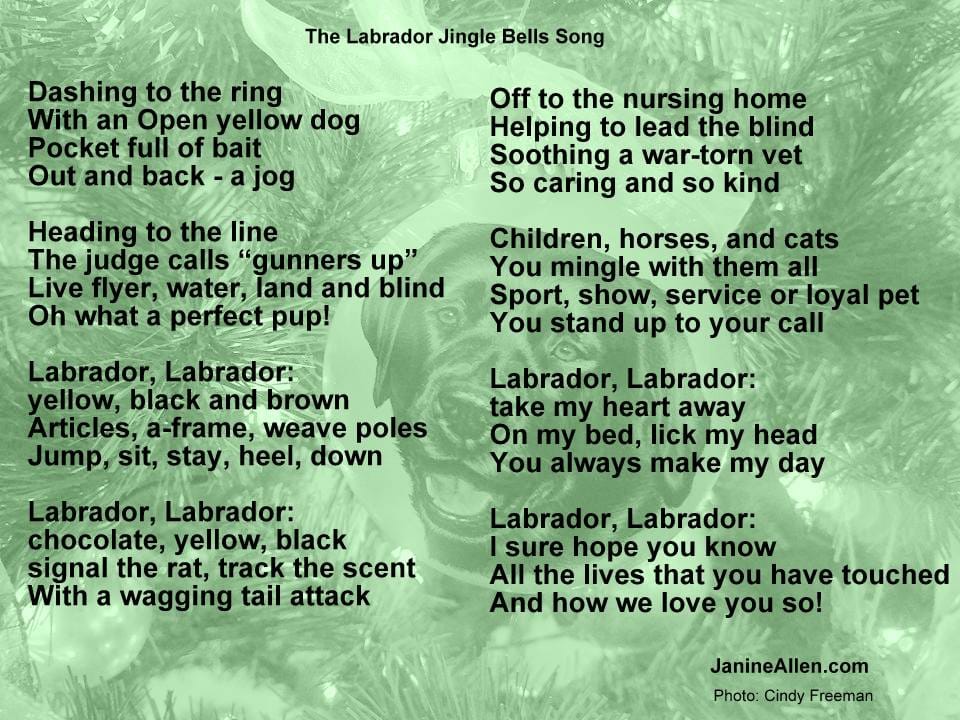
Here's a little jingle I wrote dedicated to Labradors and the people who breed, train, and compete with them. 
Picture
1 Comment

That "perfect" toy

9/11/2016

2 Comments

 
So how much time and money have YOU spent in your search for the "perfect" dog toy? Yah, me too. I finally learned. 

I learned that I will give a dog a toy and show him, foreign as it may seem, how to enjoy it.
I learned that some of the smallest dogs can cause significant damage to my most chew-proof big dog toys.
I learned that toys don't even have to be "dog toys" purchased from a pet store (mine love cardboard boxes).
I learned that there is no such thing as an indestructible toy.


I learned that it's not the amount or type of toys you give your dog, it's the time you spend with him playing with that toy.

Here are the types of toys that I have for my dogs and for client dogs:

CHEW TOYS
Somewhat indestructible hard nylon or rubber toys like those made by Nylabone, Kong, and Goughnuts.


Purpose: Satisfy dog's chewing needs, relieve boredom, mental stimulation
Pros:  Great for puppies and dogs who like to chew. Can leave dog alone with toy if it is           of appropriate size.
Cons:  Putting a piece of hard plastic or rubber in one's mouth does not come naturally           to all dogs and can be pretty off-putting for some. A common human reaction is, "He doesn't like it." My dogs hardly have a chance not to like it! I remove all other toys when introducing a chew toy and spend a lot of time interacting with the dog and toy. I might even put it on a rope and drag it around. 

TUG TOYS
Usually a rope, braided fleece, or some sort of fuzzy toy that a dog can grasp well. Only for interaction and not to be left out and available to dog.


Purpose: Playtime with owner or other dog, use for reward when training
Pros: Tugging comes pretty natural to most dogs and is a fabulous distraction when raising a sharp-toothed, mouthy puppy. Because it only comes out for short periods of time, dogs can get very excited about their special toy making it a valuable reward or reinforcer in training.
Cons: Humans tend to push the toy in a dog's face to get it to play. For many dogs this is taken offensively. Drag the toy away from the dog to get him to chase it. Over-exuberant dogs will need to be taught to settle down and not to grab human body parts during tug sessions. 
No matter the material, tug toys eventually start to shred. 

FETCH TOYS
Balls, bumpers, dumbbells

Notice how I didn't say "chase" toys? I'm talking about fetch here. If you want your dog to fetch (go after item and return it to you without making you play chase or tug) then use a specific fetch toy. Put that toy away when you are done with your play session. So much more I could write on fetching here but I won't.

STUFFED PLUSH TOYS
People pleaser toys in all sorts of fun shapes and sizes and internal sounds that make us smile. Usually found overflowing in a basket in some corner of the house.

Pros:

Any toy that makes a human happy will probably make his dog happy if said human spends time with dog and that toy.


​Cons: These things shred. If dog chews on toy in attempt to chew a piece off, take it away from him for a few moments and then give it back. Repeat. Do this each and every time he shreds the toy. He'll learn. Do not let him have toy unsupervised.

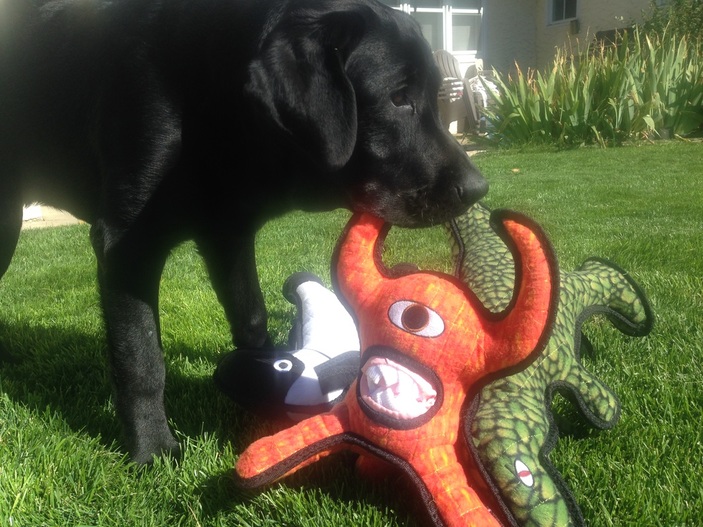
And finally, a picture of a Lab with expensive, indestructible toys. He has since chewed the ears off the white sheep.

Hugs and love to you and your dogs,

​Janine


Picture
2 Comments
<<Previous
Forward>>

    Author

    Janine Allen

    Archives

    December 2025
    October 2025
    March 2025
    September 2024
    October 2021
    September 2021
    August 2021
    December 2020
    October 2020
    March 2020
    December 2019
    August 2019
    January 2019
    December 2018
    October 2018
    April 2018
    March 2018
    February 2018
    January 2018
    December 2017
    September 2017
    August 2017
    July 2017
    June 2017
    February 2017
    December 2016
    September 2016
    May 2016
    October 2015
    February 2015
    January 2015
    November 2014
    October 2014
    May 2014

    Categories

    All
    Dog Behavior Specialist
    Palm Desert Dog Training
    Rancho Mirage Dog Training

    RSS Feed

Proudly powered by Weebly